 By Margery Hannah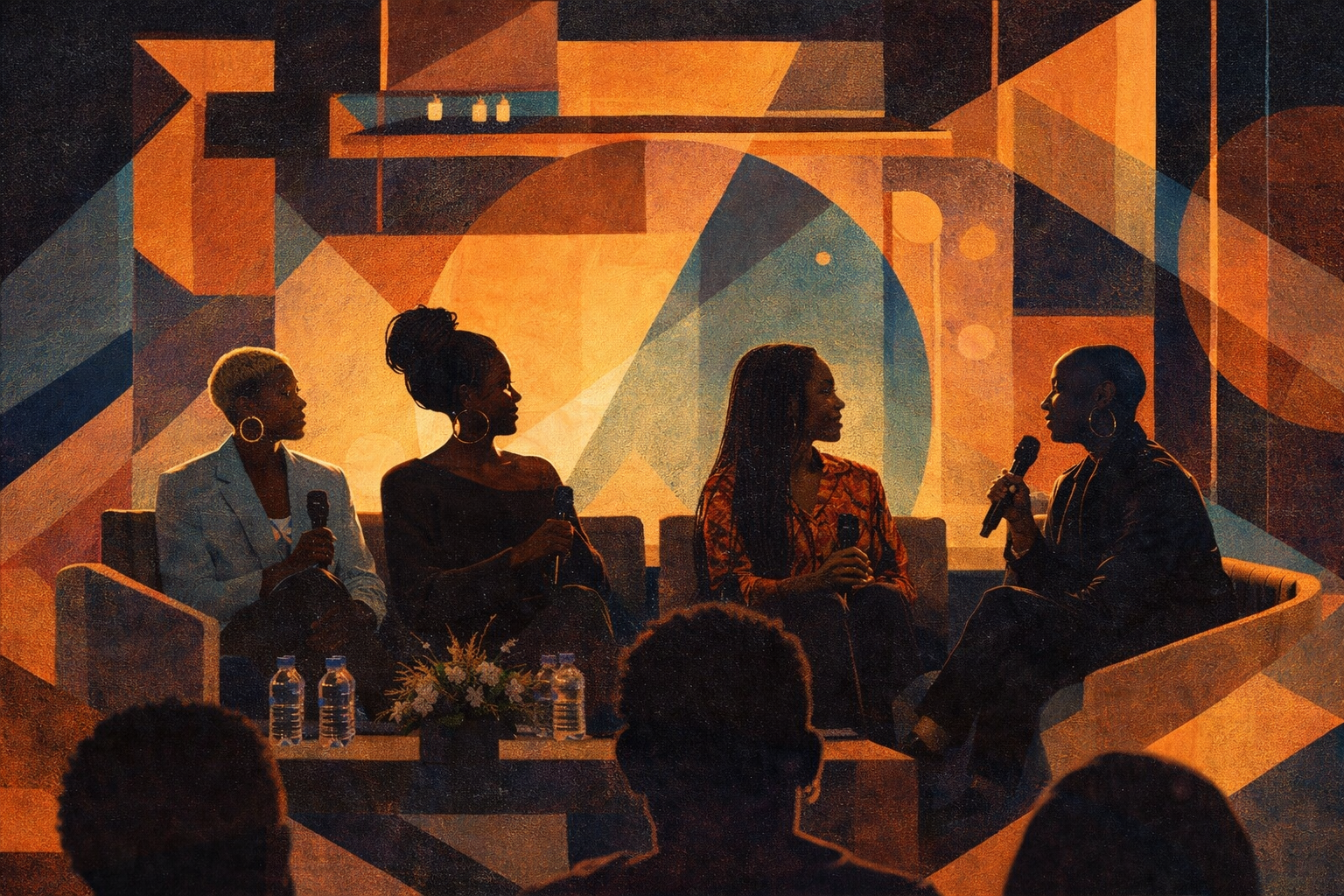
By the time I slipped into the Impact Lounge in Park City, the room had already decided it mattered. There was no casual drifting in and out. People stood shoulder-to-shoulder along the walls, and sat on the sidelines of crowded, occupied chairs. I joined them there, looking up at four Black women whose work—and whose presence—carried very different institutional weight.
Onstage were Olive Nwosu, Praise Odigie Paige, and Bea Wangondu—filmmakers whose projects were circulating in the present tense of the festival. Sitting beside them was Cheryl Dunye, the lone panelist without a screening.
The conversation moved through familiar terrain: choosing producers with intention, defining expectations before money enters the room, resisting the urge to over-translate work for audiences presumed not to understand. The filmmakers spoke about trusting the people who share their cultural codes. About making films that do not explain themselves into submission.
And then came the word that framed the night: home.
Home audience.
Home context.
Home language.
It is a powerful word, signaling intimacy and authority at once. It says: I know for whom I toll the bell; I know for whom I am making this.
But from a Black American vantage point, that word carries a double edge.
When a filmmaker from Lagos centers Lagos, it reads as cultural coherence. When a Kenyan filmmaker centers Nairobi, it is seen as artistic fidelity. When Black Americans center descendants of U.S. chattel slavery—when we name ourselves with political specificity—it is frequently interpreted as narrowing the field.
The asymmetry is subtle. But it is consistent.
It was Jidenna — the Nigerian American recording artist known for “Classic Man” and for moving fluidly between Afropolitan aesthetics and Black American sonic traditions — who pushed the word further.

During the Q&A, he asked what “global stage” actually meant. When filmmakers talk about Black stories circulating globally, who are they imagining? When they are on set, making decisions about language, accent, even something as granular as whether pidgin should be employed in a song — who is the imagined first audience?
Are you thinking about Black Americans?
Caribbean audiences in the UK?
Or are you thinking first about Nigeria? Kenya? The continent?
Cheryl Dunye, born in Liberia and raised in Philadelphia, answered first. She spoke about leaving American comfort zones, about what she learned taking The Watermelon Woman across borders. Cinema, she said, became her passport. She described watching Japanese films, collaborating internationally, thinking beyond a single audience. At one point she joked — half-joked — that she sometimes wishes she were Mexican like her wife, or from anywhere but “here,” even from a spaceship.
The room laughed.
But the line lingered.
Because wishing to be from elsewhere is not a neutral impulse for a Black American filmmaker whose work is rooted in interrogating Black American interiority. It reads as exhaustion. Or longing. Or perhaps simply a refusal to be confined to a single political geography. Still, it says something about the weight of Americanness — and about the burden of representing it.
When Praise Odigie Paige responded, her framing moved in the opposite direction. She described auditioning Nigerian actors who performed their own accents as if imitating an externalized version of Nigerian identity — a global-facing caricature of themselves. Her task, she said, was to strip that away. To insist on interior truth. To make the film mirror lived experience rather than a version engineered for export.
One orientation leaned toward borderlessness.
The other toward rootedness.
For a filmmaker whose lineage stretches four centuries on American soil — through slavery, Reconstruction, Jim Crow, redlining, and state policy — the invitation to think “bigger than Black American” carries historical weight. For filmmakers from postcolonial African nations, insisting on national specificity is an act of reclamation.
After the panel ended, I spoke with Jidenna, who was candid about his opposition to ADOSAF and its founders.
ADOSAF — the American Descendants of Slavery Advocacy Foundation — is an advocacy organization focused on policy claims tied to descendants of U.S. chattel slavery.
Jidenna’s concern, at least in part, was that delineating Black Americans through frameworks like ADOSAF risks narrowing Black identity into an American frame rather than situating it within a longer African civilizational arc. He invoked Lagos — populous, culturally dense, historically significant long before the United States formed — as reminder that Black history does not begin at the Atlantic.
Chronology is not the argument; the United States predates the modern political formation of all the African nation-states represented on that stage. Their civilizations are ancient. Their contemporary borders are not
The argument is about what four centuries on American soil produced — a distinct political and cultural formation shaped by slavery codified into law, Reconstruction amendments, Jim Crow statutes, redlining, and federal exclusion.
The tension is not about Africa versus America.
It is about whether naming a specific inheritance within the United States is treated as clarity — or as contraction.
When Jidenna raised Lagos, it was in comparison to New York — not as dismissal, but as recalibration. Lagos, he suggested, is populous, culturally dominant, too often underestimated from an American vantage point. I mentioned that I had recently visited the continent for the first time — Johannesburg, Cape Town, Durban — and he responded almost immediately: “You’ve got to go to Lagos.”
The suggestion carried momentum.
There is a growing refrain urging Black Americans to return — to invest, to bring capital and expertise, to reconnect across the Atlantic. The language is restorative: come home, build, circulate what you’ve learned.
Yet that invitation often travels alongside another refrain — that movements like ADOSAF are divisive, that delineating Black American lineage narrows the field.
Placed side by side, the contrast sharpens.
If Black Americans are encouraged to participate in a global Black project — to contribute institutional fluency, cultural capital, accumulated knowledge — what is the reciprocal posture when we articulate claims within the United States?
Many Black Americans descend from those trafficked as extracted labor during the transatlantic slave system — a regime that commodified Black bodies even as it forged a people braided from African memory, coerced European inheritance, Indigenous entanglements, and centuries of adaptation on American soil. What followed did not prevent cultural and political influence; it forged the conditions under which it emerged. Against design, infrastructure was built — cultural, legal, economic — that now circulates globally.
The question is whether engagement is mutual — or whether Black Americans remain, in quieter form, an extractable resource.
“Home” becomes elastic.
It stretches when capital is invited.
It tightens when claims are made.
And from where I was sitting — knees bent against the floor at the front of that packed room, looking up at a stage arranged in quiet hierarchy — the geometry was unmistakable.
No one said it aloud.
They didn’t have to.

 Ivory Elizabeth