 By Chelle A. Carter-Wilson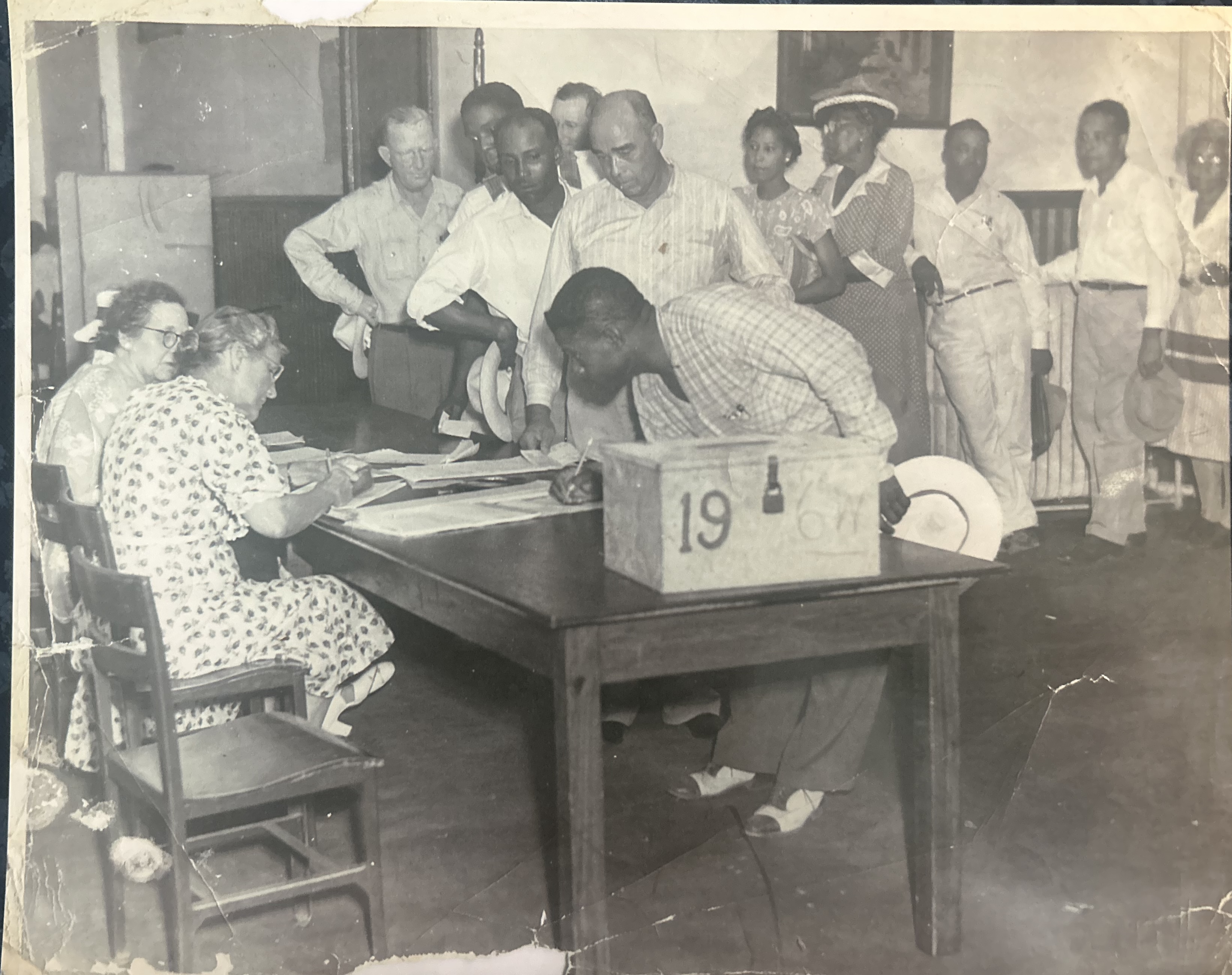
Recalling ancestral knowledge embedded deep within my soul, I describe myself as a Griotte and Empath. A griotte helps keep the past alive by commemorating it for others. Griottes sing, praise, celebrate, announce…but most of all, griottes remember. Empaths absorb and experience the feelings of others deeply. Ancestors, I feel you in my bones.
Collaborating with an extraordinary team, this year I launched a national non-partisan initiative to educate, mobilize, and encourage voter registration. Preparing for a live event before a national audience, I braced myself to share My Voter Story.
With age, I humbly embrace the mantles of those whose footsteps we follow. Ancestors, to you I declare, I understood the assignment. Despite all you might have obtained by silence or complicity, you endured suffering, bled and died to ensure my right to the full exercise of my American citizenship. Never will I dishonor the gifts you left me.
Like you, I fear only God. For me, there are no coincidences; I believe that nothing in the Universe is random. Miracles and signs exist everywhere at all times, and yet, we do not pay attention. However, on the day I would begin to frame my voter story, my morning Psalm, 34, reminded me, with these words,
“Fear the Lord, you his holy people, for those who fear him lack nothing.” Psalms 34:9 (NIV)
that I was delivered, by Grace, from all fear, save Fear of God, which is not terror but awe and reverence. Ancestors, you needed only a single whisper to capture my attention; I say again, I understood the assignment.
I do not know the origins of my most distant ancestors. I know not from whence my people came, except for what can be gleaned from ship manifests, property registers, census records, and memories recounted as oral narrative. Four-hundred-and-five years after the first known citizens of the African continent disembarked on what would ultimately be known as the United States of America, I am descended from those who refused to die, notwithstanding transcontinental kidnap, disease, and abuse. Despite generations of vitriol directed towards us, our stories will no longer remain untold.
ACT I
As the Dow sets another record on Wall Street this week, consider the origins of our global economy. The wealth of nations, the UK and much of Europe, in addition to the United States, owe their immensity to investments in slave-backed mortgage securities (SBMS). According to investopedia.com,
Mortgage-backed securities (MBS) are investments like bonds. Each MBS is a share in of a bundle of home loans and other real estate debt bought from the banks or government entities that issued them. Investors in mortgage-backed securities receive periodic payments like bond coupon payments.
What evidence substantiates this premise? Research conducted by the National African American Reparations Commission (NAARC) explains the connection between the origination and implementation of these financial instruments.
The American economy of the 1820s and 1830s was undergoing a transformation thanks to the development of new debt instruments secured by the use of slaves as collateral. The value of chattel slaves could be transferred into mortgages, securities, and bonds, like any other financial asset that could then be sold to investors nationally and internationally. The financialization of slave-assets thus allowed profiting from slavery even in places that had formally outlawed the slave trade—as had the United States, in 1808. The complex, sophisticated commercial systems that had developed along with colonial slave economies did not die when the slave trade was abolished; they merely operated from a greater distance.
Asset securitization of my ancestors are, in part, the reason for both the stock market’s historical and current success.
So, you ask, what has any of this to do with my Voter Story? Exercising my hard fought right of citizenship in the form of voting is a sacred debt of honor I pay my ancestors. While you might draw the false conclusion that this narrative focuses upon my generational trauma, therapist and author Dr. Lalitaa Sungali reminds me never to neglect my generational strengths.
Nikita Gill says it thus in her poem I Am My Ancestors Dream.
Your ancestors did not survive
everything that nearly ended them
for you to shrink yourself
to make someone else
comfortable.
This sacrifice is your warcry, be loud,
be everything and make them proud.
My right to vote is not explicitly afforded to me by the US Constitution, but by a series of amendments and legislative actions, which, to this day, remain at risk. The right to vote was originally guaranteed by the Fourteenth Amendment to “ male inhabitants… being twenty-one years of age, and citizens of the United States” not “in any way abridged except for participation in rebellion, or other crime.” The subsequent Fifteenth declared that this right should “not be denied or abridged by the United States or by any State on account of race, color, or previous condition of servitude.” That made it legal, but not universally guaranteed. While the Nineteenth declared it illegal to deny or abridge the right to vote “on account of sex” so called Jim Crow era laws severely restricted access to full exercise of citizenship, although my ancestors’ taxes always came due. Every single ballot I cast demonstrates that I will never despise their sacrifices.
ACT II
In 2012, at the age of 96, my beloved maternal grandmother, a daughter of Jim Crow’s deep south, cast her vote to re-elect as President of the United States a man whom nothing in her childhood would have suggested as a possibility. Having lived nearly the entirety of the 20th century, imagine the evolutions she witnessed. Only 4 days before the 2016 National election, on Friday, November 4, she ascended to join the ancestors. She understood her assignment, executing it with grace. As our family prepared to travel from all corners of the US to assemble for her homegoing, as the ascending elder I issued a single mandate: Every member of the family planning to attend her services was expected to provide proof of voting before embarking on the journey to lay her to rest. My elderly mother’s travel arrangements, which I made, accommodated her voting as soon as the polls opened in her state, before boarding a transcontinental flight. For the first time, I took advantage of my state’s early voting provision. Everybody was clear, channeling my grandmother, I demanded evidence. Honoring our matriarch, everyone produced receipts.
In an ongoing testament to her fierce pride and fearlessness, I show up for every election for which I am eligible, from school board, town council, state government to national contests. When afforded the opportunity to raise my voice, my warcry is loud.
ACT III
My brother recently gifted me a piece of our family history, in the form of a photograph taken by a relative who, remarkably, as a Black man, made for himself a comfortable life as professional photographer and business owner in the deep south beginning as early as the 1940s. He captured the image of another of my transcendent ancestors, my grandmother’s brother-in-law, my great Uncle Walter. This photo records his making his mark, registering to vote in the State of Texas, in the wake of the passage of the Voter Rights Act of 1965. He made his mark because, having grown up poor in Jim Crow’s deeply segregated south, he never learned to read or write. Nonetheless, I recall him as among the most successful, honorable, elegant, loving husband, father, deacon, and men I ever knew.
Even after President Lyndon B. Johnson signed the act, “literacy tests, invasive registration forms, interpretation tests, poll taxes and outright violence” continued to constrain the exercise of this right across not only the Confederate South but more broadly across the US. Uncle Walter never neglected our generational strengths, risking life and liberty to demonstrate our right to full exercise of citizenship. 59 years later, I was granted a national platform upon which to tell our voter story.
Before every national election, I look at his image. I share it because my ancestors watch me still, encouraging my steps and preserving my fortitude. My rights are not my own, but rather a mantle I wear, for now, a legacy I hold gently, and am expected to launch forward, with every step, every breath, every remaining beat of my heart, through which their blood yet flows.Their sacrifices are my war cry. I will be loud, I will be everything beyond their wildest imaginings, because it is my duty and my honor to make them proud.
Epilogue
- The New York Stock Exchange, like much of 18th century America, was built on the backs of my enslaved ancestors, in service of the American slave trade economy.
- December 13, 1711, NY City Common Council established a location on Wall St. as the first official slave market for enslaved persons.
- 304 years later, in June 2015, the City of NY dedicates a commemorative plaque.
The featured photo shows the author’s uncle casting his vote for the very first time in Austin, Texas.
 Margery Hannah